Transistors
Tutorials in This Section
Overview
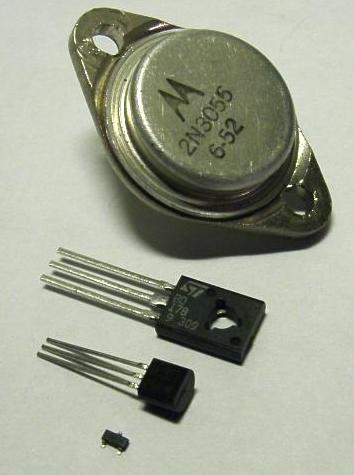
A transistor is a semiconductor device used to amplify or switch electronic signals and electrical power. It is one of the fundamental building blocks of modern electronics. A transistor is composed of semiconductor material, often with at least three terminals for connection to an voltage or electronic circuit. A current applied to one pair of the transistor's terminals controls the current through another pair of terminals. Because the controlled (output) power can be higher than the controlling (input) power, a transistor can be used to amplify a signal. Some transistors are packaged individually, but many more in miniature form are found embedded in integrated circuits. Because transistors are the key active components in practically all modern electronics, they are considered one of the 20th century's greatest inventions.
The transistor is the fundamental building block of modern electronic devices, and is ubiquitous in modern electronic systems. Following the development of the first working point-contact transistor in 1947, the bipolar junction transistor was developed in 1948. The metal–oxide–semiconductor field-effect transistor (MOSFET) was invented by Mohamed Atalla and Dawon Kahng at Bell Labs in 1959. The MOSFET made it possible to build high-density integrated circuit chips, leading to the microelectronics revolution and the era of modern electronics.
The MOSFET is the most widely used type of transistor, and is the basic building block of modern electronics. Since its invention, the MOSFET has been the subject of intense research and development, leading to the creation of various types of transistors with different characteristics and applications. The continuous scaling down of transistor sizes has enabled the development of faster, smaller, and more energy-efficient electronic devices.
In recent years, new transistor architectures such as FinFETs (Fin Field-Effect Transistors), GAA (Gate-All-Around) transistors, and MBCFETs (Multi-Bridge Channel FETs) have been developed to further improve performance and reduce power consumption in advanced semiconductor technologies. These innovations continue to drive the evolution of electronic devices, enabling the creation of more powerful and efficient computing systems.
Overall, transistors have revolutionized the field of electronics, enabling the development of a wide range of electronic devices and systems that have transformed modern life. From computers and smartphones to medical devices and renewable energy systems, transistors play a crucial role in shaping the technology landscape of today and the future.
Links of Interest
Transistor - Grokipedia
Transistor - Wikipedia